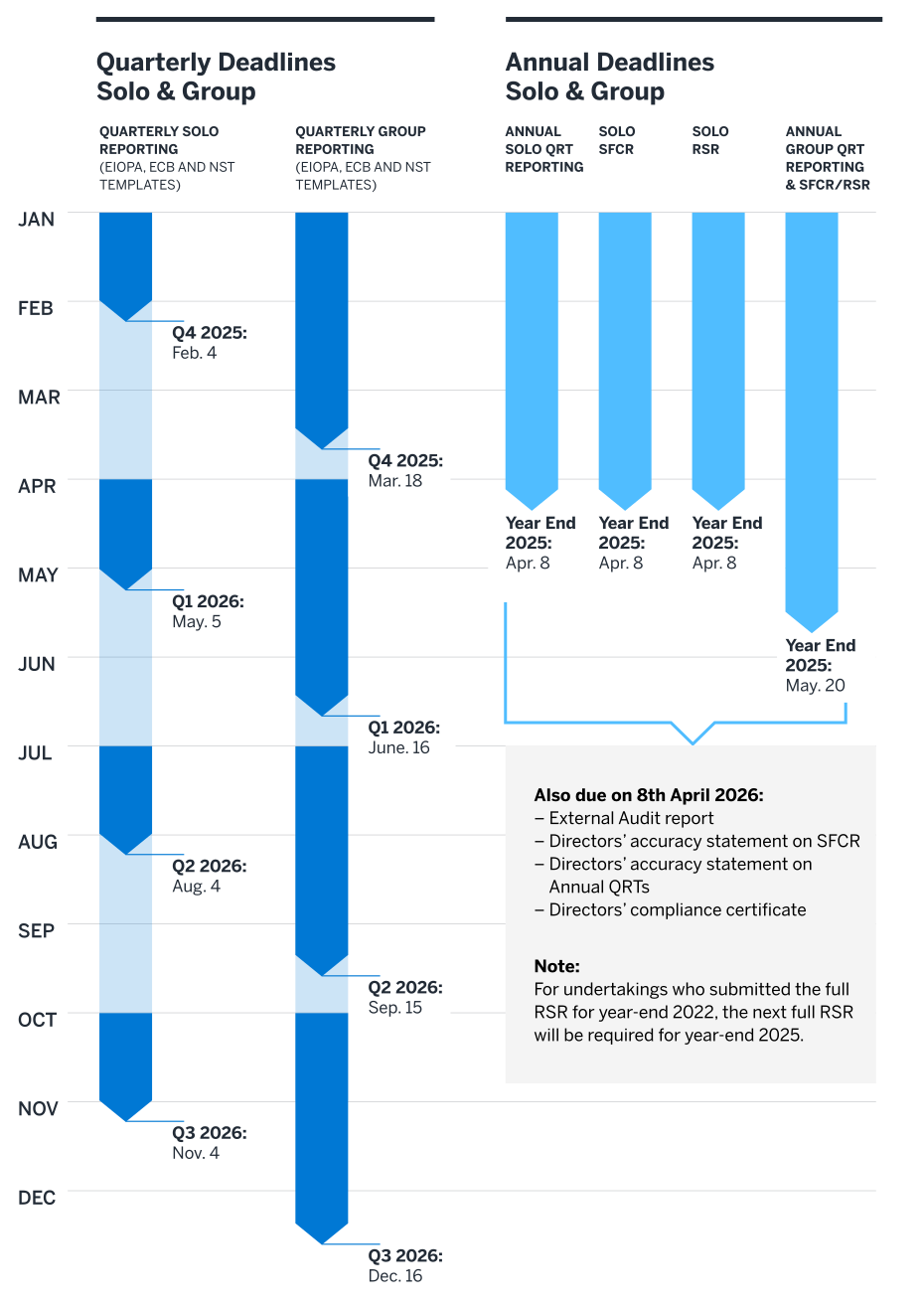
We have prepared a timeline below summarising the reporting requirements in 2026 for both solo entities and groups (assuming a year-end reporting date of 31 December 2025).
The deadline for submission of the annual reporting requirements is 14 weeks for solo undertakings, giving a submission date of 8 April 2026. The deadline for submission of the 2025 quarterly Quantitative Reporting Templates (QRTs) is five weeks for solo undertakings and eleven weeks for group undertakings, with dates for each quarter shown in the timeline below.
Annual reporting
Year-end 2025 narrative reports (the solvency and financial condition report [SFCR] and the regular supervisory report [RSR]) and QRTs need to be submitted to the regulator by 8 April 2026. The SFCR also needs to be available on the company’s website, or via an alternative means of publication, on this date. This summary refers only to solo undertakings. Group requirements are not covered here but are shown on the timeline for completeness.
The full RSR is required at least every three years (noting that regulators have discretion to require undertakings to submit their RSR at the end of any financial year). For undertakings that submitted the most recent full RSR for year-end 2022, the next full RSR will be required this year. The narrative reports and QRTs typically need to be drafted well in advance of the reporting deadlines, as the Board must approve them before publication/submission to the regulator. As part of this approval process, directors of Irish (re)insurers must submit accuracy statements to the Central Bank of Ireland (CBI) as part of the submission on 8 April. The directors’ compliance statement is also due at this time. In addition, some aspects of the narrative reports and QRTs are subject to external audit in Ireland and the audit report is also due to be completed on the reporting date.
Solvency II Review
In our paper last year, we were pleased to highlight a significant milestone in the Solvency II Review, and fortunately, we can continue this tradition this year. In December 2020, the European Insurance and Occupational Pensions Authority (EIOPA) published its opinion on the review of the Solvency II Directive. This was followed by proposals from both the European Commission and European Council. In July 2023, the European Parliament’s Committee on Economic and Monetary Affairs (ECON) approved its amendments to the Directive. Following the European Parliament’s formal adoption of amendments to the Solvency II Directive in April 2024, the European Commission released its draft amendments to the Solvency II Delegated Regulation in July 2025. This marks a key milestone on the path to the revised Solvency II framework, scheduled for implementation on 30 January 2027.
The European Commission and EIOPA have been advancing detailed guidance through successive consultation papers. EIOPA launched an initial set of seven papers in October 2024, followed by additional batches in December 2024, April 2025 and July 2025. The final set, released in October 2025, remained open for feedback until 5 January 2026. These consultations address revised technical standards and guidelines, notably on risk margin calculation and liquidity management powers.
Open consultations are available on the EIOPA website here.
With the implementation date now set for 30 January 2027, the period ahead will be busy for (re)insurance companies. Insurers must use this time to prepare for the forthcoming changes and ensure compliance with the revised framework. Many (re)insurers have already conducted impact assessments and will continue refining them as further technical details emerge.
Of particular relevance to this paper are the proposed changes to Pillar 3. Although no changes are proposed to quarterly reporting deadlines, the reporting deadlines for annual QRTs and the RSR and SFCR are scheduled to be extended. The revised annual reporting deadlines will apply from YE 2027.
Changes to the QRTs
The QRT Taxonomy 2.10.0 Public Working Draft (PWD) introduces updates to supervisory reporting and public disclosure requirements. These include significant modifications to existing templates, the removal of some templates and the addition of new templates, and changes to labels and metrics. The PWD packages do not include validations. It should be noted that the early draft may see significant changes before finalisation. The ECB add-ons introduced in this draft are under evaluation and may be revised, with only some or even none of the proposed changes potentially included in the final model. To ease the transition, EIOPA consulted stakeholders on two possible application dates: either aligning the new taxonomy with the legal acts from 30 January 2027, meaning 2026 annual reporting uses the old taxonomy 2.8.2 and Q1 2027 uses 2.10.0, or applying it from 31 December 2026 to synchronise reporting and reduce the burden, although this requires clear specification of when new items become mandatory. Industry feedback favours aligning the new submission with Q4 to maintain established practice and avoid the more burdensome and costly parallel reporting required by the January 2027 start date. The results of the consultation have not yet been released.
In June, EIOPA published a hotfix version of the Solvency II XBRL taxonomy 2.8.2. This version includes the option to use the NACE 2.1 sector classification in templates S.06.02, S.11.01 and S.37.01. Adoption of the hotfix is not mandatory; however, starting from Q4 2025, reports using this taxonomy can be submitted.
We published a briefing note on the Solvency II Review updated deadlines. You can access the briefing note here.
We also published a briefing note on the proposed amendments to the Delegated Regulation in August 2025. You can access the briefing note here.
Milliman has developed a Solvency II Compliance Assessment Tool. The tool enables companies to easily monitor and assess their level of compliance across all three pillars of Solvency II and is updated regularly to reflect changes to Solvency II requirements.
Solvency II reporting timelines in 2025 and 2026